Where Are Families Listed in the Census if They Were Not at Home During the First Visit?
| England Wiki Topics | |
| | |
| Start Enquiry | |
| |
| Record Types | |
|
|
| England Background | |
|
|
| Local Inquiry Resource | |
| |


Introduction to England and Wales Demography [edit | edit source]
| Historical populations | ||
|---|---|---|
| Demography | Pop. | %± |
| 1801 | 8,305,362 | — |
| 1811 | 9,553,021 | 15.0% |
| 1821 | 11,281,883 | xviii.1% |
| 1831 | 12,992,485 | 15.2% |
| 1841 | fifteen,002,443 | 15.5% |
| 1851 | 16,921,888 | 12.8% |
| 1861 | 18,779,811 | 11.0% |
| 1871 | 21,495,131 | xiv.5% |
| 1881 | 24,613,926 | xiv.5% |
| 1891 | 27,231,074 | 10.six% |
| 1901 | xxx,514,967 | 12.one% |
| 1911 | 33,649,571 | 10.3% |
| 1921 | 35,230,225 | four.7% |
| 1931 | 37,359,045 | 6.0% |
| Source: 1931 Census - Online Historical Population Reports | ||
The demography is a head count of anybody in the country on a given 24-hour interval. A demography has been taken in England and Wales, and separately for Scotland, every ten years since 1801, with the exception of 1941. [ane]
A well-indexed census is one of the easiest means to locate where an ancestor lived and when they lived there. You can likewise use censuses to:
England and Wales Censuses with Online Links [edit | edit source]
| 1801-1831 (Incomplete)* | 1841 | 1851 | 1861 | 1871 |
|---|---|---|---|---|
| National Archives* FindMyPast($) | FamilySearch Ancestry.com($) FindMyPast($) | FamilySearch Beginnings.com($) FindMyPast($) | FamilySearch Ancestry.com($) FindMyPast($) | FamilySearch Ancestry.com($) FindMyPast($) |
| 1881 | 1891 | 1901 | 1911 | 1921 |
| FamilySearch Beginnings.com($) FindMyPast($) | FamilySearch Beginnings.com($) FindMyPast($) | FamilySearch Beginnings.com($) FindMyPast($) | FamilySearch Beginnings.com($) FindMyPast($) | FindMyPast($) |
*1801-1831 detailed information on incomplete records
Additional Online Links [edit | edit source]
- The Genealogist Parish Registers - Derbyshire($)
- FreeCEN($)
- MyHeritage($)
Census Forms and Headings [edit | edit source]
The links below show the grade layouts and the column headings on each demography form. The headings listed the questions asked on each demography (in PDF format). Besides, Guy Etchells has assembled a drove of the official instructions given to enumerators for each census.
Understanding the Censuses 1841-1921 [edit | edit source]
In England, the government censuses have been taken every 10 years since 1801. The starting time four censuses, 1801 through 1831, were taken strictly for statistical purposes for the Overseers of the Poor and substantial households.[2]
The offset census listing people by proper noun was taken in 1841.
Census records are generally released 100 years after they were taken.
These links give detailed information on the England and Wales censuses.
- Demography returns for England & Wales
- GENUKI England and Wales:- Census
- England Demography: Further Information and Description
How the Censuses were Taken
Census details inverse little twelvemonth to yr. Each census used a pre-printed form and were taken on specific dates. The enumeration districts were small enough for an enumerator to complete his work in one day. To avoid double counting, the pre-printed form was handed past the enumerator to the caput of household with the instructions to only tape those physically located at the home on census night. Therefore those away at boarding schools, working at night, on vacation, etc. were non enumerated. Conversely, relatives, boarders, servants, etc. were enumerated. The pre-printed forms were nerveless soon after the demography date. From 1841-1901 the enumerator copied the household information onto a master form. In 1911 the original forms were kept, with each household having its own course.
The dates of each demography were as follows:
| 1841 – June 6 | 1881 – April 3 |
| 1851 – March thirty | 1891 – April v |
| 1861 – April vii | 1901 – March 31 |
| 1871 – Apr 2 | 1911 – April 2 |
| 1921 - June 19 |
Pre-1841 Demography [edit | edit source]
At that place are 791 surviving demography listings for 1801-1831 created on the parish level.[3] The few surviving pre-1841 censuses generally contain only names of the head-of-household.
- The University of Essex, Department of History published an easy to follow PDF file in 2004 entitled Census Schedules and Listings, 1801-1831: An Introduction and Guide past Richard Wall, Matthew Woollard and Beatrice Moring,
- The Online Historical Population Reports folio has statistical data available for every parish in the pre-1841 censuses.
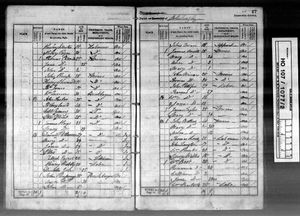
An example of an 1841 census tape
1841 [edit | edit source]
- City or borough, parish or township
- Place (street and house information)
- Proper noun of each member of the household (who stayed in the household the previous night)
- Sex/gender
- Historic period (for adults xv and up, the age was rounded downward to the lower multiple of 5)
- Occupation
- Whether or not the individual was born in the canton in which they were living. (If information technology is 'yes' , it is noted with "Y" and for 'no' it is noted with "N".)
- A column indicating if born out of the state, i.e. "S" for Scotland; "I" for Ireland
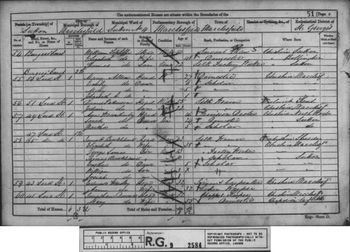
This census is meaning because information technology was the first census in England and Wales to proper name every member of a household.
1851 to 1901 [edit | edit source]
- Parish or township, ecclesiastical commune, urban center or civic, town or hamlet
- Place (house number, street and address data)
- Proper noun of each member of the household (on the night of the official demography engagement)
- Relationship to the head of the household
- Status (marital status)
- Sex/gender
- Age
- Occupation
- Parish and county of nativity (except foreign births, which usually gave country but)
- The 1851 and 1861 censuses listing whether a person was "bullheaded, deaf, or idiot."
- The 1871 and 1881 censuses list whether a person was considered "deaf & dumb, blind, imbecile or idiot, or lunatic."
- The 1891 demography added the number of rooms (if less than 5) that the family occupied.
- The 1891 and 1901 censuses list whether the person was an employer, employee, or neither.
1851: An additional census was taken of places of worship in 1851. This was a voluntary census; most places of worship participated. More data nearly the census can be accessed here. Additionally, this guide from The National Archives provides a better understand of the Ecclesiastical Census of 1851. Further data on this demography is provided by F. Coakley
1911 [edit | edit source]
- Name of each member of the household (living in the household on the dark of the official census date)
- Relationship to the caput of the household
- Age at final birthday
- Sex activity/gender
- Particulars equally to Marriage including:
- Marital condition/status
- Completed years the present matrimony has lasted
- Full (number of) children born alive
- Children (number of) even so living
- Children (number of) who accept died
- Particulars as to Profession including:
- Profession or Occupation
- Industry or service of work
- Whether an employer, worker, or working on own account
- Whether working at home
- Parish and county of nascency (foreign born but include nascence country)
- Nationality of every person born in a strange country
- Lists whether a person was "totally deaf, deaf and impaired, totally bullheaded, lunatic, imbecile, or feeble-mined"
- If able to speak in English language, Welsh, or both
- Caput of family
- Postal accost
1921 [edit | edit source]
The 1921 Demography includes these boosted questions:
- Historic period in years and month
- People born away giving a state and province
- Lists whether children were orphaned
- Lists whether previously divorced
- Lists if attention schoolhouse.
1931 [edit | edit source]
A census was held in 1931 which unfortunately was destroyed in 1942 due to a burn down unrelated to the war. Nevertheless records from Scotland take survived.
The 1939 Register [edit | edit source]
In 2015 FindMyPast released the 1939 register to the public. Information technology was a registration of the population of England on September 29th, 1939, taken for administrative purposes due to the outbreak of World War 2.
This Register was to be a critical tool in coordinating the war effort at abode. It would be used to effect identity cards, organize rationing and more.
The Annals lists full names, full dates of birth, occupations, and addresses. The register was maintained in some form up to 1991 and so changes of name upon marriage and subsequent deaths may likewise be noted.
The register is particularly significant due to information technology being 82 years one-time, less than the usual 100 twelvemonth limit, and the fact that no demography survives for 1931 and none was taken in 1941.
- 1939 How-to Video for 1939 Register
- 1939 Search Engine for 1939 Register at FindMyPast - index and images ($)
- 1939 England and Wales National Register, 1939(*) at FamilySearch - How to Use this Collection; index
- 1939 1939 England and Wales Register at Ancestry - index and images ($)
Missing Records [edit | edit source]
Various parts of the England, Wales, and Scotland census returns from 1841 to 1911 are incomplete and have pieces missing. FindMyPast has identified the known gaps by census twelvemonth, nation, canton, and village or parish in this FindMyPast article entitled "Census for England, Wales and Scotland: missing pieces".
Online Tutorials [edit | edit source]
- England and Wales Demography Records 1841-1911 Indexes
Statistical Data Gathered from the Census [edit | edit source]
There is statistical information available for every census twelvemonth from 1801 to 1931 on Histpop - the Online Historical Population Reports (OHPR) website. The statistical information records the number of houses, families, people, and other statistical information for every parish in England. Information technology allows one to see the growth of parishes and regions from census year to census twelvemonth.
References [edit | edit source]
- ↑ National Archives Census Records How to look for records of...Census records. Date Accessed: 27 Dec 2021.
- ↑ Academy of Essex PDF on the University of Essex's server Demography schedules and listings, 1801–1831:an introduction and guide pg.4 Engagement Accessed: 27 December 2021.
- ↑ Wall, Richard, Matthew Woollard, and Beatrice Moring. Census schedules and listings, 1801-1831: an introduction and guide. Colchester: Dept. of History, University of Essex. 2004.
Source: https://www.familysearch.org/en/wiki/England_Census
0 Response to "Where Are Families Listed in the Census if They Were Not at Home During the First Visit?"
Post a Comment