Everything You Need to Know About Dead Poets Society
| Expressionless Poets Club | |
|---|---|
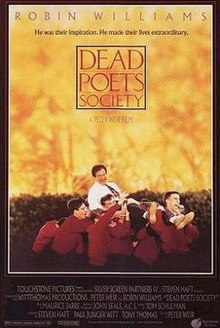 Theatrical release poster | |
| Directed by | Peter Weir |
| Written by | Tom Schulman |
| Produced by |
|
| Starring | Robin Williams |
| Cinematography | John Seale |
| Edited past | William Anderson |
| Music by | Maurice Jarre |
| Production |
|
| Distributed by | Buena Vista Pictures Distribution (The states) Warner Bros. (International)[1] |
| Release date |
|
| Running time | 128 minutes[one] |
| Country | United States |
| Linguistic communication | English |
| Budget | $16.4 million[2] |
| Box office | $235.9 million[3] |
Expressionless Poets Lodge is a 1989 American teen comedy-drama film written by Tom Schulman, directed by Peter Weir, and starring Robin Williams. Set in 1959 at the fictional elite conservative Vermont boarding schoolhouse Welton Academy,[iv] it tells the story of an English instructor who inspires his students through his educational activity of poetry.
The flick was a commercial success and received numerous accolades, including Academy Award nominations for Best Director, Best Picture, and All-time Actor for Robin Williams. The picture won the BAFTA Award for All-time Film,[5] the César Award for Best Strange Film and the David di Donatello Laurels for Best Foreign Motion picture. Schulman received an Academy Award for All-time Original Screenplay for his work.
Plot [edit]
In the autumn of 1959, shy Todd Anderson begins his junior yr of loftier school at Welton Academy, an all-male, aristocracy prep schoolhouse in Vermont. He is assigned ane of Welton's most promising students, Neil Perry, as his roommate and meets Neil'southward friends: Knox Overstreet, Richard Cameron, Steven Meeks, Gerard Pitts, and Charlie Dalton.
On the first day of classes, they are surprised by the unorthodox education methods of the new English teacher, John Keating. A Welton alumnus himself, Keating encourages his students to "make your lives extraordinary", a sentiment he summarizes with the Latin expression carpe diem, meaning "seize the day."
Subsequent lessons include having them take turns standing on his desk to demonstrate means to look at life in a dissimilar style, telling them to rip out the introduction of their poetry books which explains a mathematical formula used for rating poesy, and inviting them to make up their own fashion of walking in a courtyard to encourage them to be individuals. His methods attract the attention of strict headmaster Gale Nolan.
Upon learning that Keating was a member of the unsanctioned Dead Poets Society while he was at Welton, Neil restarts the club and he and his friends sneak off campus to a cavern where they read verse and poetry, including their own compositions. Equally the school year progresses, Keating's lessons and their interest with the social club encourage them to alive their lives on their own terms. Knox pursues Chris Noel, an attractive cheerleader who is dating Chet Danburry, a football thespian from a local public school whose family is friends with his.
Neil discovers his love of acting and gets the role every bit Puck in a local production of A Midsummer Night'south Dream, despite the fact that his domineering father Thomas wants him in the Ivy League (and ultimately medical school). Keating helps Todd come out of his vanquish and realize his potential when he takes him through an do in self-expression, resulting in his composing a poem spontaneously in front of the course.
Even so, Charlie takes things too far when he publishes an article in the school newspaper in the club's proper noun demanding that girls be admitted to Welton. Nolan paddles Charlie to coerce him into revealing who else is in the Dead Poets Society, just he resists. Nolan as well speaks with Keating, alert him that he should discourage his students from questioning authority. Keating does chide the boys (in his manner), warning that one must appraise all consequences.
Thomas discovers Neil'south involvement in the play and demands he quit on the eve of the opening performance. Devastated, Neil goes to Keating, who advises him to stand his ground and evidence to Thomas that his love of acting is something he takes seriously. As the play is about to begin, Neil claims to Keating that his father will permit him to stay in acting. All the same, information technology is unclear whether Thomas' decision was the direct result of Neil talking to him. Thomas unexpectedly shows up at the operation, and despite his son receiving a standing ovation, he takes Neil dwelling house and says he has been withdrawn from Welton, merely to be enrolled in a military academy to set him for Harvard so he will become a doctor. Unable to notice the courage to stand up to Thomas, and lacking any support from his concerned female parent, a distraught Neil kills himself.
Nolan investigates Neil's expiry at the asking of the Perry family who are unwilling to accept any responsibility for Neil's expiry, while a devastated Todd realizes that it was Neil'southward father who drove his son to kill himself. Cameron blames Neil's decease on Keating to escape punishment for his own participation in the Dead Poets Society, and names the other members. Confronted by Charlie, Cameron urges the balance of them to permit Keating take the fall. Charlie punches Cameron and is expelled. Each of the boys is chosen to Nolan's office to sign a letter of the alphabet attesting to the truth of Cameron'southward allegations, even though they know they are false. When Todd's plow comes, he is reluctant to sign, but does so after seeing that the others take complied and succumbing to his parents' pressure.
Keating is fired and Nolan takes over teaching the class, with the intent of adhering to traditional Welton rules. Keating interrupts the class to gather his leftover property. As he leaves, Todd—finding his voice—reveals to Keating that the boys were intimidated into signing the paper that sealed his fate, and Keating assures Todd that he believes him. Nolan threatens to expel Todd. Todd, in a moment of clarity, and then stands up on his desk, with the words "O Captain! My Captain!", which prompts Nolan to threaten him over again to no avail as the other members of the Dead Poets Society (except for Cameron), equally well as several other students in the grade, exercise the same, to Nolan's fury and Keating's pleased surprise. Touched past this gesture, Keating proudly cheers the boys and departs.
Cast [edit]
- Robin Williams as John Keating
- Robert Sean Leonard every bit Neil Perry
- Ethan Hawke as Todd Anderson
- Josh Charles as Knox Overstreet
- Gale Hansen as Charlie Dalton
- Norman Lloyd as Headmaster Gale Nolan
- Kurtwood Smith every bit Thomas Perry
- Dylan Kussman as Richard Cameron
- Allelon Ruggiero equally Steven Meeks
- James Waterston as Gerard Pitts
- Alexandra Powers as Chris Noel
- Leon Pownall as George McAllister, Latin teacher[6]
- George Martin equally Dr. Hager, mathematics instructor
- Carla Belver as Mrs. Perry
- Jane Moore equally Mrs. Danburry
- Kevin Cooney as Joe Danburry
- Colin Irving equally Chet Danburry
- Matt Carey as Kurt Hopkins
- John Cunningham every bit Mr. Anderson
- Lara Flynn Boyle as Ginny Danburry
Production [edit]
Development [edit]
Peter Weir had been eager to follow up his two US breakthrough hits with Harrison Ford, Witness and The Musquito Declension [ dubious ], with a romantic comedy starring Gérard Depardieu as a Frenchman who marries an American for convenience called Green Bill of fare. Depardieu was in high demand post-obit his success in the Provençal drama Jean de Florette and Weir was brash he would have to wait a year for his availability.[7]
In belatedly 1988, Weir met with Jeffrey Katzenberg at Disney (which produced the movie via Touchstone Pictures), who suggested Weir read a script recently received. On a flight dorsum to Sydney, Weir was captivated and six weeks afterward returned to Los Angeles to bandage the principal characters.[eight]
The original script was written by Tom Schulman, based on his experiences at the Montgomery Bell Academy in Nashville, Tennessee, peculiarly with his inspirational teacher Samuel Pickering.[ix] [x] In Schulman's manuscript, Keating had been sick, slowly dying of Hodgkin lymphoma with a scene showing him on his deathbed in the hospital. This was removed past Weir who deemed it unnecessary, claiming this would focus audiences on Keating's illness and not on what he stood for.[eleven]
Early notes on the script from Disney also suggested making the boys' passion dancing rather than poetry every bit well equally a new championship Sultans of Swing focusing on the character of Mr. Keating rather than the boys themselves, just both were dismissed outright.[8]
Filming started in the winter of 1988 and took identify at St. Andrew's School and the Everett Theatre in Middletown, Delaware, and at locations in New Castle, Delaware, and in nearby Wilmington, Delaware.[12] During the shooting, Weir requested the young cast not to employ modern slang, even off photographic camera.[13]
Cast [edit]
Liam Neeson originally won the part of John Keating before Peter Weir took over management from Jeff Kanew.[14] Other actors considered were Dustin Hoffman,[15] Tom Hanks and Mickey Rourke.[xvi]
Filming [edit]
During filming, Robin Williams used to fissure many jokes on set up, which Ethan Hawke plant incredibly irritating. For the scene where Todd Anderson is spontaneously incited by John Keating to make a poem in front of the class, Williams plain made a joke proverb that Hawke was intimidating, which Hawke later realized was serious and that the joke referred to his earnestness and intensity every bit a young man. Ironically, Hawke's first agent signed with Hawke once Williams told him that Hawke would "practise really well".[17]
Reception [edit]
Box office [edit]
The worldwide box office was reported equally $235,860,579, which includes domestic grosses of $95,860,116.[3] The film's global receipts were the 5th highest for 1989, and the highest for dramas.[xviii] The film was released in the United Kingdom on September 22, 1989, and topped the country's box role that weekend.[19]
Critical response [edit]
Dead Poets Society holds an 85% approving rating and average rating of 7.30/ten on Rotten Tomatoes based on 59 reviews. The site's critical consensus reads, "Affecting performances from the young cast and a genuinely inspirational turn from Robin Williams grant Peter Weir's prep school drama summit honors."[twenty] The motion-picture show holds a score of 79 out of 100 on Metacritic based on 14 reviews, indicating "by and large favorable reviews."[21] Audiences polled past CinemaScore gave the flick a rare "A+" grade.[22]
The Washington Postal service reviewer called it "solid, smart amusement", and praised Robin Williams for giving a "nicely restrained acting performance".[23] Vincent Canby of The New York Times also praised Williams' "uncommonly fine performance", while noting that "Dead Poets Lodge ... is far less about Keating than well-nigh a scattering of impressionable boys".[4] Pauline Kael was unconvinced about the film, and its "middlebrow highmindedness", but praised Williams. "Robin Williams' performance is more graceful than annihilation he's washed before [–] he'south totally, concentratedly in that location – [he] reads his lines stunningly, and when he mimics various actors reciting Shakespeare there'south no undue clowning in information technology; he'due south a gifted instructor demonstrating his skills."[24]
Roger Ebert's review was largely negative, but giving the film ii out of four stars. He criticized Williams for spoiling an otherwise creditable dramatic functioning by occasionally veering into his onstage comedian's persona, and lamented that for a movie set in the 1950s there was no mention of the Vanquish Generation writers. Additionally, Ebert described the film as an often poorly synthetic "collection of pious platitudes ... The moving picture pays lip service to qualities and values that, on the evidence of the screenplay itself, it is cheerfully willing to abandon."[25]
On their Oscar Nomination edition of Siskel & Ebert, both Cistron Siskel (who likewise gave the picture a mixed review) and Ebert disagreed with Williams' Oscar nomination; Ebert said that he would have swapped Williams with either Matt Dillon for Drugstore Cowboy or John Cusack for Say Anything. On their If Nosotros Picked the Winners special in March 1990, Ebert chose the picture show's All-time Motion picture nomination equally the worst nomination of the year, believing information technology took a slot that could have gone to Spike Lee'due south Practice the Right Thing.
Movie historian Leonard Maltin gave the picture a middling review: "Well made, extremely well acted, but also dramatically obvious and melodramatically one-sided. Notwithstanding, Tom Schulman's screenplay won an Oscar."[26]
John Simon, writing for National Review, said Dead Poets Lodge was the most quack motion picture he had seen in some fourth dimension.[27]
Accolades [edit]
American Motion picture Institute Lists
- AFI'southward 100 Years...100 Heroes and Villains:
- John Keating – Nominated Hero
- AFI'southward 100 Years...100 Movie Quotes:
- "Carpe diem. Seize the mean solar day, boys. Make your lives extraordinary." – #95
- AFI'due south 100 Years...100 Cheers – #52
The film was voted #52 on the AFI'south 100 Years…100 Cheers list, a list of the top 100 most inspiring films of all time.[41]
The film'due south line "Carpe diem. Seize the twenty-four hour period, boys. Make your lives extraordinary." was voted as the 95th greatest movie quote by the American Film Institute.[42]
Legacy [edit]
After Robin Williams' decease in Baronial 2014, fans of his work used social media to pay tribute to him with photograph and video reenactments of the film's final "O Captain! My Helm!" scene.[43]
Adaptations [edit]
Nancy H. Kleinbaum's novel Dead Poets Gild (1989) is based on the movie.[44]
Phase play [edit]
A theatrical accommodation written by Tom Schulman and directed by John Doyle opened Off-Broadway on October 27, 2016, and ran through Dec 11, 2016.[45] Jason Sudeikis stars as John Keating[46] with Thomas Mann as Neil Perry, David Garrison every bit Gale Nolan, Zane Pais every bit Todd Anderson, Francesca Carpanini as Chris, Stephen Barker Turner as Mr. Perry, Will Hochman as Knox Overstreet, Cody Kostro every bit Charlie Dalton, Yaron Lotan as Richard Cameron, and Bubba Weiler equally Steven Meeks.[47] [48]
The production received a mixed review from The New York Times, with critic Ben Brantley calling the play "blunt and bland" and criticizing Sudeikis's performance, citing his lack of enthusiasm when delivering powerful lines.[49]
In 2018, the theatrical adaptation of the motion picture, written by Tom Schulman and directed by Francisco Franco, premiered in Mexico. The Mexican role player Alfonso Herrera played the principal character.[50]
Parodies [edit]
The ending of the film was parodied in the Saturday Nighttime Alive sketch "Farewell, Mr. Bunting", in which a student, upon climbing onto his desk-bound, is decapitated by a ceiling fan.[51]
See as well [edit]
- "The Changing of the Guard", a June 1, 1962 episode of The Twilight Zone starring Donald Pleasence every bit a retiring English teacher at a New England boys' schoolhouse, who questions whether he has made a difference in the boys' lives.
- The Emperor's Club (2002), an American drama motion-picture show set in a boys' preparatory school in the northeast.
References [edit]
- ^ a b "Expressionless Poets Society". BBFC. Feb v, 1999. Retrieved June 13, 2021.
- ^ "Dead Poets Society (1989)". The Numbers. Archived from the original on April 13, 2016. Retrieved June 1, 2016.
- ^ a b "Dead Poets Society (1989) daily". Box Office Mojo. Archived from the original on June 16, 2009. Retrieved November 15, 2014.
- ^ a b Canby, Vincent (June 2, 1989). "Dead Poets Gild (1989) June two, 1989 Review/Film; Shaking Upwards a Boys' School With Poetry". The New York Times. Archived from the original on Oct viii, 2013. Retrieved November 8, 2011.
- ^ "1990 Film Film | BAFTA Awards". Awards.bafta.org. Archived from the original on September 22, 2017. Retrieved November 7, 2016.
- ^ "LitCharts". Archived from the original on July 29, 2020. Retrieved January 6, 2020.
- ^ King, James (2018). Fast Times and First-class Adventures. London: Lawman. p. 429. ISBN9781472123725.
- ^ a b Male monarch, James (2018). Fast Times and Splendid Adventures. London: Constable. p. 430. ISBN9781472123725.
- ^ "Existent-life professor inspires 'Dead Poets' character". TimesDaily. Florence, AL, United states of america: Tennessee Valley Printing Co., Inc. Associated Printing. July 10, 1989. Retrieved January 18, 2015.
- ^ Nib Henderson (January 12, 1992). "Robin Williams and then Some". The New York Times. Archived from the original on December ix, 2019. Retrieved December 19, 2007.
- ^ McCurrie, Tom (March 15, 2004). "Dead Poets Club'south Tom Schulman on the Fine art of Surviving Hollywood". Writersupercenter.com. Archived from the original on April 25, 2019. Retrieved March 31, 2015.
- ^ Cormier, Ryan (August 12, 2014) [Originally published Apr four, 2014]. "25 'Dead Poets Guild' in Delaware facts". The News Journal. Lurid Culture. Wilmington, Delaware, U.s.: Gannett Visitor. Archived from the original on December 25, 2018. Retrieved January xviii, 2015.
- ^ Male monarch, James (2018). Fast Times and Wxcellent Adventures. London: Constable. p. 433. ISBN9781472123725.
- ^ Meil, Eila (2005). Casting Might-Have-Beens: A. New York: McFarland. ISBN9780786420179.
- ^ Brady, Celia (March 1989). "Bring Back the Kids: Hollywood's Littlest Stars and Biggest Egos in their Middle Ages". Spy: 107.
- ^ Walsh, Keri (2014). Mickey Rourke. London: Bloomsbury. p. 2. ISBN9781844574308.
- ^ Bailey-Millado, Rob (August 30, 2021). "Ethan Hawke: Robin Williams was 'incredibly irritating' on 'Expressionless Poets' ready". New York Mail. Retrieved September 20, 2021.
- ^ "1989 Worldwide Grosses". Box Office Mojo. Archived from the original on June xx, 2015. Retrieved Nov 15, 2014.
- ^ "United kingdom of great britain and northern ireland Weekend Box Office 22nd September 1989 - 24th September 1989". world wide web.25thframe.co.uk. Archived from the original on December half dozen, 2018. Retrieved Dec 6, 2018.
- ^ "Expressionless Poets Society Movie Reviews, Pictures – Rotten Tomatoes". Rotten Tomatoes. Archived from the original on April 12, 2019. Retrieved September xiv, 2021.
- ^ "Expressionless Poets Society reviews at Metacritic.com". Metacritic. Archived from the original on Apr 28, 2014. Retrieved January 25, 2010.
- ^ "Why CinemaScore Matters for Box Function". The Hollywood Reporter. August nineteen, 2011. Archived from the original on April 26, 2014. Retrieved March 2, 2020.
- ^ Howe, Desson (June 9, 1989). "'Dead Poets Society'". The Washington Postal service. Archived from the original on Oct 10, 2008. Retrieved Oct 17, 2010.
- ^ Pauline Kael, Movie Love, pp. 153-157, reprinted from review that appeared in The New Yorker, June 26, 1989
- ^ Ebert, Roger (June ix, 1989). "Dead Poets Guild". Archived from the original on July 16, 2020. Retrieved July 28, 2020.
- ^ Maltin, Leonard (2008). Leonard Maltin's 2009 Movie Guide. New York: Plumage/Penguin. p. 328. ISBN9780452289789. OCLC 183268110.
- ^ Simon, John (2005). John Simon on Flick: Criticism 1982-2001. Applause Books. p. 225.
- ^ "The 62nd Academy Awards (1990) Nominees and Winners". Academy of Motion Moving-picture show Arts and Sciences. Archived from the original on July 6, 2011. Retrieved October 17, 2011.
- ^ "Nominees/Winners". Casting Society of America. Retrieved February 9, 2019.
- ^ "BAFTA Awards: Movie in 1990". BAFTA. 1990. Retrieved September 16, 2016.
- ^ "Best Cinematography in Feature Film" (PDF) . Retrieved June iii, 2021.
- ^ "The 1991 Caesars Anniversary". César Awards. Retrieved July 10, 2021.
- ^ "1988-2013 Award Winner Archives". Chicago Motion picture Critics Association . Retrieved August 24, 2021.
- ^ "42nd DGA Awards". Directors Lodge of America Awards . Retrieved July 5, 2021.
- ^ "Dead Poets Social club – Gold Globes". HFPA . Retrieved July 5, 2021.
- ^ "1989 Award Winners". National Board of Review . Retrieved July 5, 2021.
- ^ "Film Hall of Fame: Productions". Online Film & Television Association . Retrieved June 6, 2021.
- ^ "6th Warsaw Motion picture Festival". Warsaw Film Festival . Retrieved Feb vi, 2022.
- ^ "Awards Winners". wga.org. Writers Guild of America. Archived from the original on December v, 2012. Retrieved June half-dozen, 2010.
- ^ "11th Annual Youth In Picture show Awards". YoungArtistAwards.org. Archived from the original on April 9, 2014. Retrieved March 31, 2011.
- ^ American Moving picture Plant. "AFI'due south 100 YEARS...100 CHEERS". Afi.com. Archived from the original on March 20, 2016. Retrieved Baronial thirteen, 2014.
- ^ American Film Institute. "AFI's 100 YEARS...100 MOVIE QUOTES". Afi.com. Archived from the original on April 15, 2015. Retrieved August 13, 2014.
- ^ "Robin Williams death: Jimmy Fallon fights tears, pays tribute with 'Oh Captain, My Captain'". August 13, 2014. Archived from the original on September 1, 2014. Retrieved November fifteen, 2014.
- ^ Kleinbaum, North.H. (1989). Dead Poets Lodge . New York: Hyperion. ISBN978-1-4013-0877-iii. OCLC 71164757.
- ^ Clement, Olivia (Feb 29, 2016). "CSC to Stage World Premiere of Dead Poets Society". Playbill.com. Archived from the original on November 9, 2016. Retrieved December 8, 2016.
- ^ Itzkoff, Dave (August 16, 2016). "Jason Sudeikis to Star in Stage Version of 'Dead Poets Society'". The New York Times. Archived from the original on October 17, 2016. Retrieved December 8, 2016.
- ^ Cloudless, Olivia (September 14, 2016). "Dead Poets Society Finds Its Complete Bandage". Playbill.com. Archived from the original on October 21, 2016. Retrieved December 8, 2016.
- ^ Clement, Olivia (October 27, 2016). "The World Premiere of Dead Poets Society Begins Tonight". Playbill. Archived from the original on October 31, 2016. Retrieved December 8, 2016.
- ^ Brantley, Ben (November 17, 2016). "Review: 'Dead Poets Society,' Starring Jason Sudeikis as the Idealistic Teacher". The New York Times. ISSN 0362-4331. Archived from the original on December 8, 2016. Retrieved December 8, 2016.
- ^ "La sociedad de los poetas muertos". carteleradeteatro. March 5, 2018. Archived from the original on April iv, 2019. Retrieved December 11, 2020.
- ^ Silverberg, Nicole (May 23, 2016). "Behold, a New Classic 'SNL' Sketch". GQ. Archived from the original on September 29, 2017. Retrieved June 23, 2016.
Further reading [edit]
- Munaretto, Stefan (2005). Erläuterungen zu Nancy H. Kleinbaum/Peter Weir, 'Der Gild der toten Dichter' (in German language). Hollfeld: Bange. ISBN3-8044-1817-1.
External links [edit]
- Expressionless Poets Social club at IMDb
- Dead Poets Order at Box Role Mojo
- Expressionless Poets Gild at Rotten Tomatoes
- Dead Poets Society at Metacritic
Source: https://en.wikipedia.org/wiki/Dead_Poets_Society
0 Response to "Everything You Need to Know About Dead Poets Society"
Post a Comment